
Fearnhill School
Subject Areas at Key Stage 3 & 4
Art
Year 7 Art – Building Confidence
Building knowledge of the formal elements and experimenting with diverse artistic media.
In Year 7, students start to build strong creative foundations through exploration and experimentation. They learn and practice essential skills such as shading, drawing, collage, printmaking, while developing an understanding of the Formal Elements Of Art — Line, colour, tone, texture, shape, form and composition.
Students are encouraged to take creative risks, record their ideas in a sketchbook, and discover how artists use these elements to create inspiring work. Throughout the year, they complete four exciting projects: The Formal Elements, Carolee Clark & Pete Cromer Inspired Artwork, Insects, and Under the Sea— combining knowledge and skill with imagination and creativity.
Year 8 Art – Developing Skills
Discovering the importance of Art Movements.
In Year 8, students build on the strong foundations of Year 7, taking their skills and creativity to the next level. They develop a deeper understanding of visual devices such as perspective, scale, proportion, depth, and image manipulation, while also beginning to think more critically about how artists use these tools.
A key focus is on exploring art movements in their historical context, helping students see how art reflects and influences society. They will dive into exciting styles such as Pop Art, Op Art, Cubism, Impressionism, Street Art and Graffiti, as well as exploring the powerful connections between art and music.
Throughout the year, students are encouraged to experiment with new media, bold styles, and fresh ideas, producing a wide range of outcomes that reflect different artistic approaches and viewpoints. By combining practical skills with research and reflection, they gain a richer, more confident understanding of art and its place in the world.
Year 9 Art – Shaping their own Artistic Journey
In Year 9, students take their artistic journey to a deeper level, building on the strong foundations of Years 7 and 8 while preparing for the step into GCSE Art. They revisit the formal elements and principles of design, but with fresh approaches — experimenting with different media in bold and exciting ways.
This year places a strong emphasis on independence and confidence. Students learn to investigate, research, develop, experiment, and refine their ideas, strengthening their skills through regular practice and reflection.
The main theme, Human Form, challenges students to explore the contrast between realism and abstraction in portraiture, encouraging them to think critically and creatively about how identity and expression can be represented through art.
In the second half of the year, students take part in a GCSE taster project with the theme “Sweet Treats”. This introduces them to the skills, processes, and higher-level thinking required at GCSE, ensuring they build the knowledge and confidence needed for a strong and successful start in Year 10.
Year 10 & 11 Art – Getting Immersed
GCSE Art and Design is where creativity really takes off! Students are encouraged to take risks, push boundaries, and dive deeper into themes and ideas, working with greater complexity and confidence. They refine their skills while exploring drawing, painting, printing, and sculpture — experimenting with new media and techniques to create work that is more sophisticated and individual.
Alongside practical skills, students develop their ability to think like artists. They don’t just look at what artists create, but explore how and why they make their work — considering social context, comparing different approaches, and discovering how culture shapes creativity, whilst embracing their effective visual style.
At Fearnhill, our GCSE Art and Design course is designed to spark both imagination and expression, offering opportunities across a wide range of traditional and digital practices. Students also step beyond the classroom, visiting galleries and taking part in workshops to experience artwork first-hand, gaining inspiration and fresh perspectives for their own creative journeys.
YEAR 12 & 13 – Expressing Your Creative Voice
At A Level, students push their creativity further, working with greater independence, depth and confidence. The course encourages them to develop a personal artistic style, taking ideas from first spark through to final realisation.
Students experiment with a wide range of media – from painting, drawing and sculpture to photography, film, printmaking and installation – while exploring art and design across cultures and time. They also gain critical and contextual understanding, learning to discuss and analyse art with confidence.
A Level Fine Art is a chance to refine skills, expand imagination and grow as a practising artist. It offers both challenge and freedom, preparing students for creative opportunities wherever their future takes them.
EXAM BOARD LINKS
- GCSE Art and Design (Fine Art Endorsement) Exam Board: OCR
- A Level Art and Design (Fine Art Endorsement) Exam Board: AQA
CLUBS AND ACTIVITIES
- Student and teacher led lunch clubs – technique and the joy of making
- Gallery and museum visits
- Local artist workshops
- Exhibitions of work with opportunities for curation
- Alumni visits from ex Fearnhill art students who have built careers in the subject.
USEFUL WEBSITES
The National Gallery
The Tate
BBC Bitesize
www.theartstory.org
www.studentguide.com
www.art2day.co.uk
Business
In Business we mean business and are ready to support students to become successful individuals in our society.
Our vision is to train young individuals to become skillful entrepreneurs who learn to take meaningful risks in order to become successful.
At Key Stage Three Business is not taught as a separate subject. It is a GCSE option so is started at the end of Year 9.
YEAR 10 & 11
At Fearnhill we study GCSE (9-1) Business which is made up of two sections. Business 01 is taught at Year 10 to equip students with the understanding of business activities and marketing. Business 02, taught in Year 11, is designed to allow students to take a closer look at operations, finance and influences on business.
The final exam is categorised into two parts:
- Paper 1 (Business 01): Business activity, marketing and people. Marks: 80 Duration: 1 hour 30 mins Weighting: 50%
- Paper 2 (Business 02): Operations, finance and influences on business Marks: 80 Duration: 1 hour 30 mins Weighting: 50%
The examination board for GCSE Business Studies is OCR.
YEAR 12 & 13
There are choices for students wishing to study Business in the Sixth Form. A Level Business follows the course with AQA. Students are taught a range of topics from four themes. There are three exams for students to complete at the end of the sixth form.
ASSESSMENT
More details can be found here
FAQs
Who can I contact if I have any other questions?
Miss Cordon
Can I visit the school to get further information?
Yes. Call the school office on 01462621200 to arrange a visit.
USEFUL WEBSITES
Accordion content
Careers
Alumni Event
On Friday 13th March we will be holding our annual Careers Alumni Event, in which former students come into school to chat to our students about their career path and what their role involves.
Ms Balchin, our Head of Careers, would love former students to share their career stories to inspire our current students. It doesn’t matter what your journey has been since leaving school – bank manager or basketball player, barista or barrister – come and let our students talk to you about your career path. If you’d like more information on how you can be involved in our Careers Event on Friday 13th March 2026, please email admin@fearnhill.herts.sch.uk
This successful event is held every year. Download this year’s handbook here.
Careers Education
‘The best way to predict the future is to prepare for it.’
At Fearnhill, our vision for careers education is to widen horizons, challenge stereotypes and raise aspirations. We aim to provide young people with the knowledge and skills necessary to make successful transitions into the next stage of their life, to connect learning to the future and in so doing, motivate young people to understand and navigate a clear pathway to rewarding future jobs and careers.
Careers education is an integral part of the PSHE programme, with specific programmes for each year group. The careers education programme aims to prepare students for working life after school and help them develop to their full potential. Activities are aligned with the 8 Gatsby Benchmarks which are current, best practice delivery for careers education and guidance in schools.
For more information about the support offered by Services for Young People visit the jobs & careers section of their website.
To request an appointment with the personal adviser, students should speak to Mrs Balchin or their form tutor.
We compile and send out a fortnightly newsletter – Careerfile – which is packed full of the latest careers advice and opportunities.
We are always looking for ways to engage our students in work related learning experiences and through employer interaction. If you feel you could offer work experience, a talk or a number of sessions regarding your business, employability skills and/or how to be successful in the work place, please get in touch by emailing admin@fearnhill.herts.sch.uk and writing ‘employer engagement’ in the subject line.
Please see below for details of our whole school careers programme.
National Apprenticeship Week
For information relating to National Apprenticeship Week 2026, please see the following:
Amazing Apprenticeships Parents’ Zone
Sixth Formers Guide to Degree Apprenticeships
YEAR 7
In Year 7, students experience Enterprise Day, developing their personal skills and qualities, exploring the JED careers software, investigating future careers and qualification routes, as well as taking part in an ‘Apprentice’ style hat design competition.
YEAR 8
In Year 8, students take part in ‘Take your Sons and Daughters to Work Day’. This helps to grow links between work and school. Students also benefit from Services for Young People personal advisor interviews.
YEAR 9
Year 9 focuses on Key Stage 4 options preparation, looking at future routes, learning styles, decision making and of course options evening. There is a trip to the University of Hertfordshire as well as Services for Young People personal advisor interviews.
YEARS 10 & 11
Students prepare for one week’s work experience in March (WEX). This involves looking at what employers want, expectations of the work place, health and safety, application forms, Link 2 database search, LMI and writing letters to employers. There are also RAF talks, trips to careers events and access to the Barclays Business mentors scheme. Services for Young People personal advisor interviews are also available.
In Year 11 support is offered around Post 16 option choices and routes-college, sixth form, apprenticeships, and Labour Market Information (LMI). CV writing and interview skills are covered, as well as options evening and Enterprise Day. For this, students set up a business to tender for the school prom. There is an Interview Day with external employers, a sixth form buddy scheme to support learning, apprenticeship talks and the Barclays Business mentors scheme. All students have the opportunity for a Services for Young People personal advisor interview.
Student Pathways in Hertfordshire – post 16
Year 10 Work Experience – This is in the calendar for the Summer Term 2026 in order to give students a taster of the world of work. Over the coming months, in the build up to Year 10 going into the workplace, we will be providing sessions to help them set goals and know what is required of them in the work place in order to have a successful week of work in the summer term. We also encourage students to seek work experience through family and friends during their free time in order to gain knowledge of the work place. We pride ourselves on our work experience successes over the years and the invaluable opportunity that serves to develop their employability skills. In whatever format work experience takes, it will continue to be an experience that opens the students eyes to the opportunities available, the skills required of them with the evidence of participation being a crucial addition to their cv.
YEARS 12 & 13
Students continue their Careers, Education and Guidance programme within their PSHE lessons in the sixth form. Information and advice on options after 18 is available in the Sixth Form Study Area.
USEFUL WEBSITES
Labour Market Information – Click on the widget tab and select the Careerometer
Amazing Apprenticeships Parents’ Zone
Hertfordshire Opportunities Portal
Five practical ways to improve your CV
How to balance work and study as a student
How to help your child with job applications
Job versus career: what’s the difference and why should I plan ahead?
What are soft skills and why are they important?
University and Your Future – Career Planning and Making the Most of Your Degree Course.
Sixth Formers Guide to Degree Apprenticeships
Please click here for the Application for Provider Access document.
Please click here for the Careers Education Information Advice and Guidance policy.
Computing & Computer Science
Equipping pupils with the technological skills of tomorrow.
Fearnhill Computing aims to produce computer literate students to meet the challenge of today’s workplace and to encourage the safe use of computers for educational, work and recreational purposes. Computing is taught from Year 7 through to Year 11. There are a range of topics designed to meet the demands of the workplace.
Key Stage 3 Scheme of Work Overview
The curriculum covers key topics across multiple units, including:
- Online Safety & Cybersecurity
- Computer Systems & Networks
- Programming (Scratch & Python)
- Spreadsheets & Data Science
- Computational Thinking
- Web & Presentation Development
- 3D Animation & Digital Media
Students will explore how computers process information, develop coding skills, and enhance digital literacy.
Year 10 and Year 11
GCSE Computer Science (OCR J277 specification): Component 01 provides students with many opportunities to develop their understanding of computer processors, memory and storage, data representation, network topologies, system security and system software alongside the ethical, legal, cultural and environmental aspects of computer science. Component 02 uses lessons and opportunities to undertake programming tasks that develop students’ computational thinking skills and their understanding of programming techniques and algorithms, computational logic and translators (compilers and interpreters).
EXAM BOARD LINKS
USEFUL WEBSITES
Design & Nutrition
YEAR 7
In Year 7 students will gain experience of investigating materials across food ingredients, fabrics and fibres, electronics and all form of resistant materials, ie card, boards, plastics, woods and metals. Students learn to draw accurately to communication design, focusing on measurement and creating unique nets of their own creation in the shape of an animal.
YEAR 8
In Year 8 students will build on their prior knowledge and undertake more challenging tasks across fundamental 3d design skills incorporating challenge and accuracy. Students take on the design and production of a 3 dimensional speaker.
In Food Studies, students will work in the kitchen to gain confidence in their core cooking and baking skills whilst gaining knowledge of balanced diets and health and safety issues.
YEAR 9
In Year 9 students will hone their modelling and design skills, ready for their 3d Design GCSE option. Focusing on a clear theme, students will investigate related artists and create a bespoke 3d piece, in line with their findings and interests. Exploration of materials and experimentation with equipment is the foundation of Year 9.
In Food Studies, students will continue to develop high level practical skills whilst looking in more detail at the hospitality industry as a whole. They will be encouraged to consider a client when creating dishes and discussing accommodation and catering outlets.
YEAR 10 & 11
Level 1/2 Award in Hospitality and Catering
The Eduqas Level 1/2 Award in Hospitality and Catering is a brilliant look into an industry that at some point will employ many young people. The course has two units. Unit 1 is Catering based looking at nutrition, cooking methods and practical skills and makes the basis of the controlled assessment element. Unit 2 looks at the structure, job roles and working responsibilities of people in the hospitality industry and is tested through the end of Year 11 summer exam.
What you will study?
· All elements of food hygiene and safety.
· The factors effecting food choice.
· Environmental issues surrounding the catering industry.
· Balancing food consumption and a healthy lifestyle for individual groups of people.
· Planning and preparing a two course meal in response to a given brief.
· The types of accommodation and facilities within hospitality providers.
· Rating systems and types of contracts.
· Job roles in both front and back of house hospitality teams.
Unit 1: Catering (controlled assessment)
In Unit 1 we look at how we respond to a brief and entwine excellent hygiene and practical skills into this. We learn how to construct and execute a two course menu from scratch in a given time slot and how to adapt recipes to make the outcomes more supportive of a healthy and balanced lifestyle. Topics such as environmental issues, client food choice and the effects of cooking on nutrients is all tested in this section.
Unit 2: Hospitality (external exam)
In Unit 2 we look more at the hospitality industry as a whole: job roles, types of establishments and working contracts. Within this we will explore what makes a 5* hotel superior to others, what responsibilities fall under what job description and how customers select different accommodations and locations to suit their exact needs. We will continue some practical elements looking more at suitability for different types of service styles and customer dynamic.
Child Development: (OCR, J818)
This specification helps students develop their knowledge and understanding of child development issues in a diverse society and enables them to work in a variety of contexts. The two tasks for the controlled assessment provide a choice of a wide variety of topics and account for 50% of the overall marks. There is also a written exam which makes up the other 50%.
Whilst this course is intended to introduce students to the overall needs and development of young children, it includes related aspects of home, food, family, health and other socially appropriate issues.
What will you study?
Students will study, research and evaluate topics such as family, birth and care of the baby, children’s developmental stages, plus types and benefits of play.
Whilst a large percentage of the syllabus requires factual knowledge, research and application, it is essential that all students following this course have regular contact with a child who is under five years of age in order to complete the child study task.
For the Child Study, students will be required to plan two activities to carry out with the child and observe that young child in the child’s home environment.
ASSESSMENT
More details can be found below.
EXAM BOARD LINKS
- www.edexcel.com
- www.aqa.org
- http://www.ocr.org.uk/qualifications/vocational-education-and-skills/cambridge-nationals-child-development-level-1-2-j818/
- http://www.wjec.co.uk/qualifications/creative-and-media/creative-and-media-level-1-2-certificate/
USEFUL WEBSITES
Drama
“Drama is life with the dull bits cut out.” – Alfred Hitchcock
Drama at Fearnhill School builds successful relationships, raises confidence levels and improves skills needed in all subject areas. Pupils are encouraged to co-operate, communicate and contribute to group and class situations, put ideas and theories into practice through thoughtful presentation of their practical work and observe, analyse and discuss their achievements.
YEAR 7
Topics include: Myth and Legends, Mime, Magic and WW1.
YEAR 8
Topics include: Silent Movies, Runaways, Documentary Theatre and Murder Mystery.
YEAR 9
Topics include: Verbatim Theatre, Civil Rights, Performing Script and Shakespeare.
YEAR 10 & 11
We follow Eduqas GCSE Drama. This course gives students the opportunity to explore plays, theatre styles, themes and issues in a highly creative and practical way. Emphasis is placed on team work and learning through experience. Students are assessed in practical activities and they also complete written course work. There are two performance exams and one written exam during Year 11.
YEAR 12 & 13
BTEC Performing Arts Level 3 option combines music and drama. Students here explore what it means to be a performer, investigate a practitioner, create a group performance to a stimulus and deliver workshops and learn new performance skills.
ASSESSMENT
More details can be found below.
EXAM BOARD LINKS
CLUBS AND ACTIVITIES
There are extra-curricular opportunities each year for students throughout the school to become involved in. There is an annual whole school production and a weekly drama club.
USEFUL WEBSITES
English
The English Department wants to promote a curiosity about learning and an active interest in language and literature, demonstrating to students how to develop their writing, reading and speaking and listening skills. Our belief is that all students can enjoy reading, and we aim to encourage this through introducing them to a wide range of texts, both in class and independently at home after our fortnightly guided library lessons. It is fundamental that students continue to develop their vocabulary and comprehension so they can achieve their potential and although this is supported across all subjects, it is at the core of everything we do.
Students are taught in mixed-ability groups from years 7 to 11 and study a range of challenging texts from different time periods and cultures throughout. We intersperse each scheme of learning with specific literacy skills that complement the unit being taught and ensure we are continuing to build confidence and embed the core disciplinary skills and knowledge they will need to be successful at GCSE and beyond.
YEAR 7
In Year 7 students’ study:
- Extracts: Myths and Legends
- Poetry: Poetry Through the Ages
- Modern Novel: A Bone Sparrow
- Non-fiction: You are a Champion
- Shakespeare play: A Midsummer Night’s Dream
YEAR 8
In Year 8 students’ study:
- Extracts: Dystopian Fiction
- Poetry: Passport to Poetry
- Shakespeare: Extracts from Much Ado about Nothing, The Merchant of Venice, Twelfth Night and Hamlet
- Modern Play: Blood Brothers
- Victorian Visionaries: Oliver by Charles Dickens
YEAR 9
In Year 9 students’ study:
- Extracts: Gothic Fiction
- Poetry: Unseen Poetry
- Novel/Extracts: Diverse Texts
- Shakespeare play: Macbeth
- Speaking and Listening and Non-fiction: Inspiring Voices
In the year prior to GCSE study, we focus on developing the maturity and accuracy of students’ reading, writing, and speaking and listening skills. This culminates in the completion of their Speaking and Listening award at the end of year 9 which is an additional certificate that is awarded alongside their English GCSE at either Pass, Merit or Distinction level.
YEAR 10 & 11
Years 10 & 11 students are entered for both AQA GCSE English Language and English Literature. During this time, students develop the necessary skills to enable them to be successful in the world of work. They refine their reading, writing and speaking and listening skills. In addition to this, students also develop and refine their appreciation of a wide range of literary texts including: Shakespeare’s ‘Romeo and Juliet’, Dickens’ ‘A Christmas Carol’, the AQA Power and Conflict Poetry Anthology and Priestley’s ‘An Inspector Calls’.
A flier for an external English Literature Revision course can be found here.
YEAR 12 & 13
In Years 12 and 13, students study AQA A Level A – Option B English Literature. During this time, students read a wealth of English Literature including works by Shakespeare, F Scott Fitzgerald, Margaret Atwood and many more. They also develop their appreciation of literary techniques and the ability to write critical analysis of unseen texts. An important part of the course involves the non-exam assessment (NEA) where students have the freedom to choose the books they study and the themes they would like to explore in more depth and detail.
ASSESSMENT
KS3
Students get feedback on their progress every half term through an in class marked piece and they are tested on their key vocabulary and the disciplinary knowledge they have picked up in each unit. Twice a year this is a full assessment which is fed back to parents. Over the course of each year they develop their skills of creative, transactional and analytical writing, reading, comprehension, inference and deduction, as well as developing their metacognition, exploratory and presentational speaking and listening.
KS4
Year 10: Students get feedback on their progress every half term through an in class marked piece based on the content they have covered. Twice a year this is a full assessment which is fed back to parents. The latter being a full mock of one language and one literature paper at the end of Year 10.
Year 11: Students get feedback on their progress every half term through an in class marked piece based on the content they have covered. They also have two mock periods across the year. They revise and sit one full language and one full literature paper for each.
KS5
Year 12: Students get regular feedback on homework and essays completed. There are also two formal assessment periods the latter being when they are assessed on one full paper at the end of the year. They also start working on their NEA in the Summer term of Year 12.
Year 13: Students get regular feedback on homework and essays completed. There are also two mock periods where they are assessed on both full papers that make up their A Level. They also complete their NEA in the Autumn Term of Year 13.
EXAM BOARD LINKS
- http://www.aqa.org.uk/subjects/english/gcse/english-language-8700
- http://www.aqa.org.uk/subjects/english/gcse/english-literature-8702
- https://www.aqa.org.uk/subjects/english/as-and-a-level/english-literature-a-7711-7712
CLUBS AND ACTIVITIES
The English Department organises a variety of extra-curricular and enrichment activities including: Books and Biscuits Reading Club, Creative Writing Club and participation in debating competitions. There is also ‘Fearnzine’ a magazine written by the students for the students, which is live on the website here. We also try to organise regular author visits and theatre trips to inspire and develop students’ understanding and enjoyment of English.
At Fearnhill Year 10 Opinion Articles you will find a collection of opinion articles produced by our Year 10 students on a wide range of topics – from religion to music; from social media to snowflakes; from feminism to narcissism. Some of these are controversial; some are designed to get you thinking; some are intended to make you laugh. Whatever your reaction, we hope you enjoy!
Humanities
“You must be the change you wish to see in the world.”
Our mission of Humanities at Fearnhill School is to ensure that the students understand that the world we study is their world and that they are a part of it. We want to teach the students that they are not sitting on the side-lines of the world, but they are part of the world and if they want to see change then they can be that change and make that change.
Humanities at Fearnhill School is divided into three separate subjects: Geography, History and Philosophy, Religion and Ethics (PRE)
Key Stage Three Humanities students study three lessons of Geography and History every two weeks and two lessons of PRE.
Our mission at Key Stage Three is to provide the students the knowledge and understanding platform of all the Key Stage Four topics allowing them to then build on from this during their GCSEs. All Key Stage Four (GCSE) topics are covered in Key Stage Three.
At Key Stage Five we also offer the options of A level Psychology, Level 3 Criminology, A level Geography and A level History.
YEAR 7
Geography Topics
Where are we? Maps.
How can we feed 8 billion people? Farming and Food.
Why do the British talk about the weather? Weather and Climate.
Where do we live? Settlement.
What’s Great about Britain? UK Geography.
Can we ever stop crime? Geography and Crime.
History Topics
How did the Anglo-Saxons shape England?
How did William the Conqueror control England?
Did a medieval king have complete control?
Meanwhile elsewhere….
How Christian were the Tudors?
Philosophy, Religion and Ethics (PRE) Topics
The Big questions
The Big 6
Respect
Christianity part 1
Christianity part 2
Humanism
YEAR 8
Geography Topics
Why is there inequality in the world? Development.
What makes the world go around? Trade.
Are floods natural or manmade? Rivers and Flooding.
What is the Holocene? Ecosystems and TRF.
What is Energy? Consuming Energy?
What’s my carbon footprint? Energy Sustainability.
History Topics
Why did Royal Authority collapse?
How did the Industrial Revolution change Britain?
What was life like in the British empire?
What caused the French Revolution?
How did WW1 change the world?
Philosophy, Religion and Ethics (PRE) Topics
Sikhism
Introduction to Philosophy
What is a Moral issue
Islam
Martin Luther King and civil rights
Buddhism
YEAR 9
Geography Topics
How many people can our world manage? Population.
Which is better prediction or preparation? Plate Tectonics.
Why are coasts so important to people? Coasts.
Is tourism good or bad? Tourism.
Are all rocks hard? Rocks and The Rock Cycle.
History Topics
How did one man change the lives of millions? 1914-1918
Why did people vote for Hitler? 1918-1939
Why should we remember the Holocaust?
What was the impact of WW2?
How did the world change after WW2?
Philosophy, Religion and Ethics (PRE) Topics
Judaism
Extremism
Issues of life and death part 1
Issues of life and death part 2
Community Cohesion
Start of GCSE – Islamic beliefs.
KEY STAGE 4 – YEARS 10 & 11
GCSE Geography: Specification Edexcel Geography B.
The Specification covers 9 topics and includes 3 exam papers.
Content overview
Topic 1: Hazardous earth.
Topic 2: Development dynamics
Topic 3: Challenges of an urbanising world.
Topic 4: The UK’s evolving physical landscape – including sub-topics: Coastal change and conflict and river processes and pressures.
Topic 5: The UK’s evolving human landscape – including a case study: London.
Topic 6: Geographical investigations – including one physical fieldwork investigation: coastal conflict at Walton on Naze and one human fieldwork investigation: regeneration success in Stevenage.
Topic 7: People and the biosphere.
Topic 8: Forests under threat.
Topic 9: Consuming energy resources.
GCSE History: Specification AQA
Content overview
The GCSE History content comprises the following elements:
Paper 1: Understanding the modern world. Written exam: 2 hours, 50% of GCSE.
One period study: Germany, 1890–1945: democracy and dictatorship.
One thematic study: Conflict and tension: The inter-war years, 1918–1939
Paper 2: Shaping the nation. Written exam: 2 hours, 50% of GCSE.
One wider world depth study: Britain: health and the people: c1000 to the present day.
One British depth study including the historic environment: Elizabethan England, c1568–1603.
GCSE PRE: Specification AQA A
Content overview
Component 1: The study of religions: beliefs, teachings and practices: Christianity and Islam.
Written exam: 1 hour 45 minutes.
50% of GCSE.
Component 2: Thematic studies.
Theme A: Relationships and families.
Theme B: Religion and life.
Theme E: Religion, crime and punishment.
Theme F: Religion, human rights and social justice.
Written exam: 1 hour 45 minutes
50% of GCSE.
KEY STAGE 5 – YEARS 12 & 13
History
Students study 2 modules which are a depth study on the Tudors 1529-1570 and a breadth study on Tsarist and Communist Russia 1855-1964. Students also have to complete a non exam assessed unit on a historical topic of their choice.
Geography
Edexcel: Unit 1 – Dynamic Landscapes (Tectonic Processes and Hazards and Coastal Landscapes and Change), Unit 2 – Dynamic Places (Globalisation and regenerating Places).
Edexcel: Unit 3 – Physical Systems and Sustainability (The water cycle and water security and the carbon cycle and energy security). Unit 4 – Human systems and Geopolitics (Superpowers and Migration, Identity and Sovereignty).
Psychology
Topics studied:
Research Methods in Psychology (including mathematical understanding of data)
Core Studies
Child Psychology
Mental Health
Criminal Psychology
Criminology
Topics studied:
Changing awareness of crime
Criminological theories
Crime scenes to courtroom
Crime and punishment
Sociology
Topics studied:
Families and households,
Education with Theories and Methods
Globalisation
Crime and Deviance with Theories and Methods
EXAM BOARD LINKS
Links to exam board information for GCSE, BTEC & A Levels for each exam covered by faculty
CLUBS AND ACTIVITIES
Geography
Trips include:
Year 7 – Letchworth Town Centre
Year 9 – Natural History Museum, London
Year 10 – Walton on the Naze – Coastal Investigation
Year 11 – Letchworth
Year 12 – Flatford Mill, Field Study Centre, Suffolk
Year 12 – Stevenage
Year 12 – Bayfordbury Study Centre, Hertfordshire University
History
We run a well attended and vibrant history club including collaboration with historic England to explore the local area.
History Trips:
Year 7 – walk to bronze age burial site and iron age hill fort
Year 9 – Duxford
Year 11 – Hastings
PRE
There is an active Christian union in school and we also have a dedicated prayer room for our Muslim students to access.
PRE Trips:
KS4 Mosque visit and St. Albans Cathedral plus local churches
External visitors are often brought in to work with students on various topics.
USEFUL WEBSITES
IMPORTANT INFORMATION
Please note, parents and carers have the right to withdraw their children from any/all RE (PRE) lessons. If this is the case, please email admin@fearnhill.herts.sch.uk
Mathematics
“To most outsiders, modern mathematics is unknown territory. Its borders are protected by dense thickets of technical terms; its landscapes are a mass of indecipherable equations and incomprehensible concepts. Few realize that the world of modern mathematics is rich with vivid images and provocative ideas.” Ivars Peterson
At Fearnhill, we expect you to:
- Be able to recall your times tables (up to 12).
- Come to school prepared with your maths equipment with you for every maths lesson (pen, pencil, ruler, protractor, compass, and calculator).
- Attempt to use mathematical vocabulary during your maths lessons.
- Follow the maths department expectations when presenting your work.
- Work collaboratively with peers and have mathematical discussions.
- Regularly use online resources for independent learning.
- Engage fully in your homework, completing it to the best of your ability.
KEY STAGE 3 (KS3) – YEARS 7, 8 & 9
Over the first three years of secondary education we focus on developing students’ ability to solve problems in a range of contexts and become independent learners. Our aim is to prepare all students adequately for the expected skill levels required at KS4. This we achieve by enabling previously high attaining students from KS2 to be challenged through the skills they learn as well as the context they see them in. We also build on the level of arithmetic ability and consolidate the basic skills learned at KS2. Our scheme of learning is also built to develop all students to spot correct skills from language in problems. We achieve this in part by structuring units of learning into tasks that can be built from a single concept. Given that the key stage 3 national curriculum lays most of the basic skill work required for KS4, learning is geared towards understanding why something works as well as application of rules and skills. Teachers use a variety of approaches to achieve this.
Each year, the students study five blocks which build upon each other throughout the course of the key stage.
KEY STAGE 4 (KS4) – YEARS 10 & 11
Students will follow the Edexcel exam board for their GCSE and cover a range of mathematical topics under the following headings: number, algebra, ratio, proportion & rates of change, geometry & measures, probability and statistics.
The GCSE qualification consists of three equally weight written examination papers at either Foundation or Higher tier. The maths GCSE supports students in developing their resilience by them having to unpick complex problems and learn how to apply their maths skills to multi-step problems.
KEY STAGE 5 (KS5) – YEARS 12 & 13
A Level Mathematics taught at Fearnhill follows the Edexcel specification.
The curriculum consists of three main strands: pure mathematics, statistics and mechanics. In pure mathematics, students start by developing their skills in topics familiar to them at GCSE but are soon introduced to new techniques such as differentiation and integration, logarithms and exponentials.
The statistics content introduces models and methods that enable students to interpret and conduct sophisticated statistical studies, perform hypothesis tests and solve more complex problems involving probability.
Mechanics is the field of applied mathematics that models how objects behave when moving or acted on by a combination of forces. Students undertake a more mathematical problem-solving approach than what is covered in A Level physics but students taking both subjects will benefit from overlap between the two courses.
In summary, the A Level in mathematics provides students with a comprehensive and powerful set of tools which can be employed in other subjects as diverse as economics, chemistry and the humanities. Students with A Level mathematics are also in demand by employers as success on the course demonstrates commitment and an ability to solve problems in creative and structured ways.
ASSESSMENT
Students have regular in class assessments every half term to check their progress. Following every assessment, students are provided with a personal learning checklist which guides them on their next steps to make further progress.
More details can be found below.
EXAM BOARD LINKS
RESOURCES
There are a variety of online resources available to students at all key stages, including My Maths, MathsWatch, Seneca Learning and Integral Maths. We also use Oak Academy lessons for our virtual curriculum. These online platforms have interactive lessons, walkthroughs, practice questions and exam style questions for the students to use. MathsWatch also has tutorial videos on every topic that is on the syllabus so students can use this to self-study/revise topics in their own time.
In Year 11 and at Key Stage 5, we provide all students with a ‘Maths Bible’ which consists of a large bank of practice exam papers. This helps build their confidence with exam style questions and prepare them for their external examinations.
CLUBS & ACTIVITIES
Maths Support club runs every lunch time in the computer rooms in the maths block. There is always a member of the maths team available to help the students with any problems the students may have.
Staff also run a Board Game Club for students. This is a good chance for the students to game socially but also build their problem solving and logical skills as they tackle different strategic games each week.
We will give all students the following opportunities:
- Represent your house in a Fearnhill Mathalon.
- Regularly participate in times tables challenges.
- Raise money for the NSPCC on National Number Day. Participate in a maths puzzle during form time.
- Become ‘Maths Student of the Half Term’.
- Attend Homework Club to receive support or challenge yourself further.
- KS3 students have the opportunity to assist with the running of the Primary Mathalon.
- KS4 students have the opportunity to coach KS3 students by assisting with homework club.
- KS5 students have the opportunity to coach KS4 students by running intervention sessions.
- Participate in our annual numeracy fair
- Participate in national ‘Pi Day.’
ADDITIONAL OPPORTUNITIES
There are plenty of opportunities for high performing students in the maths department at Fearnhill. We provide the opportunity to participate in the annual UK Maths Challenges at the Junior, Intermediate and Senior level. This can lead to recognised awards and possible entry into subsequent rounds which test the best students in the country. We are also building our presence in team challenges in the area such as attending the advanced maths support programme’s Year 10 Maths Feast. As well as this, students can get stuck into the department’s super curriculum which enables them to qualify for the ‘Fearnhill Flyers’ programme.
FAQs
- Do we need to buy text books?
No, we provide all text books that students need however optional revision resources are offered at discounted prices to students. Letters are sent home about these resources at the relevant time. - Do we need a calculator?
Yes though they are not used every lesson, students should have their own scientific calculator. Throughout their time at Fearnhill, we will teach them how to use it effectively in preparation for their GCSE exams. - What other equipment will they need?
Pen, pencil, ruler, eraser, protractor and a pair of compasses.
USEFUL WEBSITES
- MyMaths
Initial login: Fearnhill – Initial password pyramid - MathsWatch
Login: Surname followed by first initial @fearnhill
e.g. williamse@fearnhill Password: password (unless the student has changed it) - Integralmaths
Used for A Level – students are given individual log ins. - Senecalearning
Modern Foreign Languages
“Learning another language is not only learning different words for the same things, but learning another way to think about things.” Flora Lewis (American journalist)
The Modern Foreign Languages department is dedicated to offering our students Spanish and French at all key stages of the curriculum and the opportunity to extend their proficiency in the chosen language to the highest possible level. We value the importance of learning a foreign language in our school curriculum as it helps to shape personal qualities and abilities in all our students, such as determination, self-confidence, focus, problem-solving skills and open-mindedness. It also has a positive influence on your understanding of your mother tongue.
YEAR 7
All students in Year 7 will be allocated either Spanish or French, consolidating and extending any prior knowledge from KS2. This will include topics such as my family and friends, my town, my free time activities, my studies and customs and festivals.
YEAR 8
All students continue their study of their allocated language, engaging with new topics, consolidating previous learning and communicating in different tenses. This will include topics such as my life at school, food and travel and tourism.
YEAR 9
All students continue their study of their allocated language, extending topic areas and communicating in a range of tenses. This will study topics such as healthy living, career choices and future ambitions, visits to French/Spanish cities and role models.
YEAR 10 & 11
It is highly recommended that all students continue with their allocated language at GCSE level. The KS4 courses build upon the knowledge and skills acquired at KS3 and students have the opportunity to sit the final GCSE examination at either Foundation or Higher tier.
We follow the AQA specification. Students will learn to communicate effectively through listening, speaking, reading and writing, and through understanding how each language is constructed. Students will make use of different media in the target language.
YEAR 12 & 13
We offer the opportunity to study French & Spanish at AS/A2 level as part of the Letchworth Sixth Form Consortium. Students build on the skills and knowledge from GCSE allowing students to discuss and debate contemporary social issues at an advanced level in the target language.
The A2 curriculum has a broad content covering current affairs and includes cultural topics through the study of a book and a film. Students work closely with teachers to improve their speaking and listening skills.
EXAM BOARD LINKS
- http://www.aqa.org.uk/subjects/languages/gcse/spanish-8698
- http://www.aqa.org.uk/subjects/languages/gcse/french-8658
- http://www.aqa.org.uk/subjects/languages/as-and-a-level/spanish-7692
CLUBS AND ACTIVITIES
Lunch time revision sessions are available and there is a Languages After School Club. Past trips include: Christmas Market to Lille, cultural trips to Barcelona and Madrid, Spain.
USEFUL WEBSITES
Music
“When words fail, music speaks.”
At Fearnhill, we believe in providing opportunities and experiences for all students to get involved with different styles and types of musics from around the world and through the ages.
YEAR 7
Units include Rock and Roll, Instruments of the Orchestra, Ukulele, Performance
Masterclass, Film/Cartoon Music and Rhythms and Notes.
YEAR 8
Units include Blues, Reggae, West African Drumming, Ensemble skills, the Bass-ics (bassline and bass clef) and Protest music – power through music.
YEAR 9
Units include Film Music, Rap, Hip Hop and Dance music, Band Skills (popular
music), Samba and Dance Music from around the world (Tango and Waltz).
YEAR 10 & 11
Do you enjoy performing music, on your own or in groups? Do you like making up your own music? Do you enjoy listening to different types of music? If you can answer ‘Yes!’ to these questions, then the GCSE Music course may be for you! We have recently started studying the Eduqas syllabus which combines Performing (30%), Composing (30%) and Listening/Appraising (40%). For the exam, we study and analyse 2 pieces in depth (Badinerie by JS Bach and Africa by Toto) and then we work on learning the fundamental elements of music to be able to discuss other music from many different genres.
YEAR 12 & 13
There are two paths of study for music at Post 16. You can study A-level Music (Edexcel) which combines Performing (30%), Composing (30%) and Listening/Appraising (40%). We do not currently have an A-level cohort but if there are enough candidates then a class can be offered.
There is also the BTEC Performing Arts Level 3 option which combines music and drama. Students here explore what it means to be a performer, investigate a practitioner, create a group performance to a stimulus and deliver workshops and learn new performance skills.
ASSESSMENT
More details can be found below.
EXAM BOARD LINKS
CLUBS AND ACTIVITIES
Fearnhill Wind Band, Fearnhill Choir and Ukulele club are currently on offer as extra-curricular clubs. We have a new group starting called Fearnhill Rocks which is for pop and rock instruments. Students can also book practice rooms at break and lunch to rehearse their own music.
The music department is also heavily involved in the yearly School Production. The most recent shows include Oliver, Back to the 80s, The Addams Family and School of Rock to name a few. We also put on a yearly Christmas concert and perform regularly in the community at events such as the Letchworth Christmas Lights switch on.
We are proud to offer students at Fearnhill the opportunity to experience various musical and theatrical shows with trips to both local and London based musicals and concerts for students to attend and broaden their musical experiences. Finally, for KS4 students, we have Musical Theory/Coursework Support running one lunchtime a week – to help you read music better, analyse scores and to generally improve your ability and confidence in the music exams.
FAQs
- Can I pay for instrumental lessons?
Yes – we provide instrumental lessons from Herts Music Service. Full and part funding is available for students on pupil premium. - Do GCSE music students get funded instrumental lessons?
Yes – students taking GCSE music currently receive school funding for 15 minute instrumental/vocal lesson.
USEFUL WEBSITES
Physical Education
YEAR 7
Activities in Year 7 include units on – Netball, Basketball, Rugby, Tag Rugby, Football, Badminton, Hockey, Health Related Fitness, Gymnastics, Dance, Athletics, Tennis, Table Tennis Rounders, Cricket, Dodgeball, Handball & Lacrosse.
YEAR 8
Studying the same activities, students will deepen their level of knowledge in each activity and develop not only higher order skills, but also their tactical and strategic thinking.
YEAR 9
As students move into their final year of KS3 PE, the emphasis is on the ability to apply advanced skills and develop fluency and creativity within the activities. As students progress through the key stage they are consistently challenged to improve their consistency and develop the personal attributes associated with successful individuals inside and outside of sport.
YEARS 10 & 11
The aim of Key Stage 4 Core PE is to provide students with activities that will encourage them to take part in a healthy and active lifestyle beyond school life.
For GCSE we follow the AQA syllabus. This is made up of: Theory 60%, externally examined, Practical 40%, internally assessed/externally moderated. GCSE PE is open to students who excel in science and participate in school teams or external sports clubs. We do expect students to have shown full participation, enthusiasm and appropriate conduct during their KS3 PE lessons.
YEARS 12 & 13
KS5 A-Level Physical Education: AQA. The course is 30% practical assessment based on performance in one sport and the analysis of another individual’s performance in that sport. 70% is then assessed through 2 exams which focus on a wide range of sporting concepts which develop on from GCSE PE. Students will have 8 hours of teaching across a fortnight whilst studying this course and it is essential that further reading and studying takes place outside the classroom to sufficiently cover all topics.
ASSESSMENT
Details coming soon.
EXAM BOARD LINKS
- GCSE
http://www.aqa.org.uk/subjects/physical-education/gcse/physical-education-8582 - A Level
http://www.aqa.org.uk/subjects/physical-education/as-and-a-level/physical-education-7582
ASPIRATIONAL
PE groups are taught in mixed sets as we feel it is imperative to provide an inclusive and supportive environment for all. This further challenges our students to reach their potential. All pupils are given the opportunity to further their understanding of performing skills as well as by leading, coaching and officiating peers or groups of peers. Pupils will also be given a detailed knowledge of the human body and how to lead an active healthy and balanced lifestyle. Throughout the year the school will compete at house competitions in PE which are rounded off with a whole school sports day in the summer term.
Curriculum Autumn 25
Please see our curriculum for all year groups for Autumn-2 2025 here.
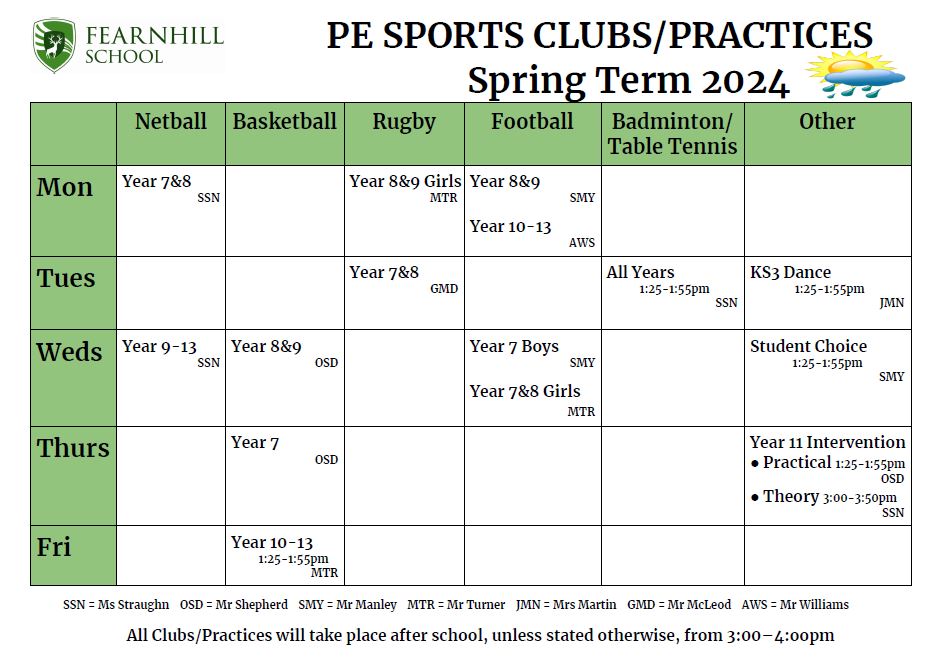
PE Clubs and Practices
Details of our Spring term PE clubs and practice sessions can be viewed HERE.
PSHE/RSE
Fearnhill PSHE & RSHE Programme KS3 & 4
RSHE FAQs for Secondary School Parents and Carers
Our PSHE/RSHE Policy can be found on our Policies page here.
Science
“The important thing is to never stop questioning.” Albert Einstein
In this ever evolving technological world, we aim to equip our students with the scientific skills and knowledge necessary for success. We strive to give our students the opportunity to discover and explore the world around us through engaging lessons and practical investigation.
YEAR 7
In mixed ability groups, students will cover topics such as cells, body systems, reproduction, particles, elements, acids, alkalis, forces, sound and space.
YEAR 8
In mixed ability groups, students will cover topics such as health, ecosystems, adaptations, periodic table, separation techniques, metals, energy, motion and electricity.
YEAR 9
In mixed ability groups, students will begin the KS4 syllabus, focusing on key scientific techniques in bio-mimicry, cell structure, atomic structure and the particle model.
All students are equipped with a secure foundation of scientific skills and confidence on which to build at KS4.
YEAR 10 & 11
In Years 10 and 11, students are taught in sets based on ability and progress made during KS3. Biology, chemistry and physics are taught to all students as separate subjects by teachers normally specialist in the subject. Students will study either AQR Separate Sciences leading to three GCSEs in biology, chemistry and physics or Combined Science leading to two GCSEs in science.
YEAR 12 & 13
A Level Biology
Biologists follow the OCR Biology A course. This course teaches the biological content in a wide range of areas such as genetics, biodiversity, ecology and immunology. It is examined with three written papers at the end of a student’s study.
A Level Chemistry
Chemists follow the OCR Chemistry A course. Chemical concepts are introduced within a relevant context, with students studying a series of units in a spiral way so that chemical ideas, introduced in an early topic, are reinforced later on.
A Level Physics
Physicists follow the content led approach of the AQA specification. Students build on their knowledge of the laws of physics, applying their understanding to solve problems on topics ranging from subatomic particles to the waves, electricity to nuclear physics.
ASSESSMENT
Below is an example of the work expected and assessed:
EXAM BOARD LINKS
- KS3 Science: https://global.oup.com/education/content/secondary/series/activate/?region=uk
- KS4 Science: https://www.aqa.org.uk/subjects/science
- KS5 Biology: http://www.ocr.org.uk/qualifications/as-a-level-gce-biology-a-h020-h420-from-2015/
- KS5 Chemistry: http://www.ocr.org.uk/qualifications/as-a-level-gce-chemistry-a-h032-h432-from-2015/
- KS5 Physics: https://www.aqa.org.uk/subjects/physics/a-level/physics-7408/specification
CLUBS & ACTIVITIES
- Science club
- Gardening Club
- Annual Science Fair
- Science Week Activities
- Faraday Challenge
- Nuffield Research Placements
- SETPOINT Engineering Challenges
- GCSE Revision Sessions
- Big Bang Fair
- Whipsnade Zoo Ecological Trip
- Homework Help Clinics
- Royal Air Force Roadshow
FAQs
WHAT RESOURCES/FACILITIES ARE THERE?
As well as having their own textbooks, students are also encouraged to improve their skills using computer technology which allows a wide variety of motivational and educational activities in every lesson. The department houses 8 fully stocked science laboratories, a large prep room and two study rooms for exam years. The department possesses a large amount of practical equipment, which is used by students at appropriate times.
HOW ARE PUPILS SET IN SCIENCE?
Years 7, 8 and 9 are taught in form groups in a combination of mixed ability groups. Since this move away from setting across the board, we have achieved some of our highest results and can report increased motivation within lessons.
CAN PUPILS MOVE OR WORK THEIR WAY UP TO A HIGHER SET?
Pupils can move between sets at KS4 based on test results and continuous teacher assessment.
WHAT DIFFERENT OPTIONS ARE THERE IN GCSE SCIENCE?
In Years 9 and 10 students follow either combined or separate science routes. We also offer an entry level science certificate, leading to the combined science GCSE. Students will be placed into sets at the start of KS4. The top set will follow the separate science route.
CAN STUDENTS MOVE BETWEEN ROUTES?
Yes, at several points we can move students in Years 10 and 11.
HOW ARE STUDENTS ASSESSED IN YEARS 10 AND 11?
For students currently in Year 9 and moving into Year 10, assessments will take the form of regular end of topic tests across all three sciences. Students will sit terminal external exams at the end of Year 11.
The combined science course is assessed by 6 terminal exams in the Summer of Year 11 each lasting 1 hour 10 minutes. There will be two papers in biology, two in chemistry and two in physics.
The separate science route will also be assessed in 6 terminal papers, two in each subject, each lasting 1 hour and 45 minutes.
USEFUL WEBSITES
- www.kerboodle.com/users/login
Username and password is your initial and surname e.g. dwilson, Institution code EU2 - www.bbc.co.uk/bitesize/secondary
- www.gcsescience.com